Good writing isn’t about density or long words—it’s about clarity. The best writing feels intuitive and helps readers feel better informed and even smarter. That principle shaped Rudolf Flesch’s breakthrough 1945 study, Marks of a Readable Style, which was based on years of research into what makes text easy or hard to read.
What Is Readability?
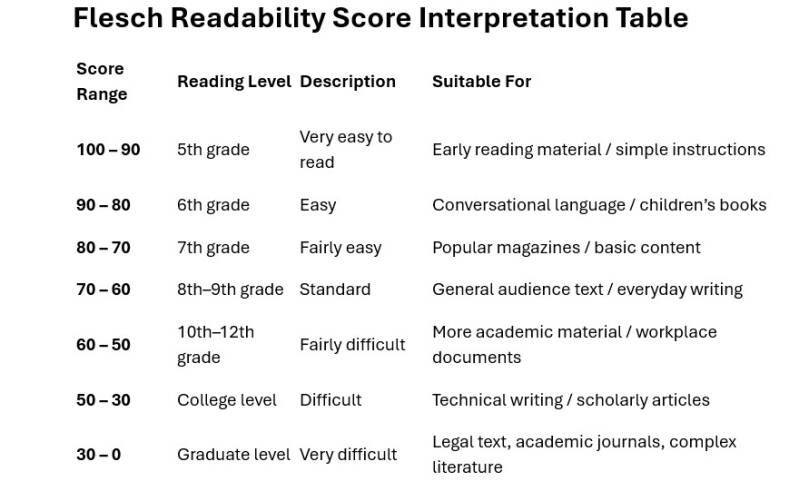
Readability measures how difficult a text is to read—whether it’s an article, instructions, an email, or anything else. The Flesch tool scores writing from 0–100 based on sentence length and word syllables, with higher scores meaning easier text.
Just before Flesch’s system emerged, psychologist Irv Lorge identified five major factors affecting difficulty: hard words, prepositional phrases, sentence length, abstract words, and affixed morphemes.
Affixed Morphemes—What Are They?
A morpheme is the smallest unit of meaning in a word. Affixed morphemes—prefixes, suffixes, and other add-ons—shape complexity. Though rarely discussed outside linguistics, they’re everywhere in writing: counterfactual, posttrial, next-level, etc.
Scoring Your Writing
Flesch scores also correlate with grade level. A simple line like “A cat sat by the pie” earns a first-grade readability rating of 95. My article on AI training avatars scored 63 (9th-grade level), while Once Upon a Time in Anderson Park scored at an 8th-grade level.
Why Readability Matters Daily
If you’re learning something new—say tort law or hip surgery—starting with 9th-grade-level material makes the ideas far easier to grasp than jumping straight into dense academic texts. Good readability supports people in many ways. Learning, staying healthy and safe, filling out necessary forms, growing as a human, and being a well-informed citizen.
Why Flesch Still Dominates
Eighty years later, the Flesch system is standard across government, insurance, academic benchmarks, and widely used media. Most public writing targets an 8th–10th grade level, while patient education aims even lower. Microsoft Word still uses Flesch as its built-in readability expert.
Readability and AI
When I prompt AI, I often request a 9th-grade reading level. AI models were trained on readability systems like Flesch and can generate text calibrated to those expectations.
Readability matters because it creates access. As Flesch wrote, “There are many books written for the few, but few written for the many.” Even in a digital age, readable writing still opens doors—and transforms learning.